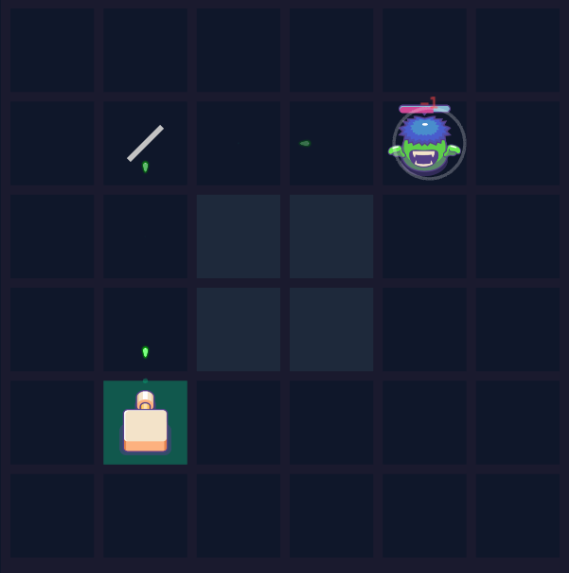
Of the three games on erandel.com, Vectron is the hardest to explain. If I say "tower defense", you picture placing towers and watching them melt waves of enemies. Vectron does have towers and waves, yes, but the real game is not where you put the tower — it is where the bullet travels after it leaves it.
Vectron in one sentence
You defend a space station from creatures advancing toward your core. You place turrets that shoot, but you also place reflectors and repeaters that bend the path of the projectiles. Winning is not about having more firepower, but about steering the firepower you already have to where it does the most damage.
Reflectors: the mechanic that changes everything
A reflector changes the angle of a bullet that hits it. It sounds small, but it breaks the basic rule of the genre. In a normal tower defense, a turret only covers what is in front of it. In Vectron, a single well-aimed turret can cover half the map if you make its shot bounce through two or three reflectors before it reaches an enemy.
That turns every level into a geometry question: not "where is there room for another tower?", but "how do I make this bullet pass through here, turn there, and end up crossing the corridor the enemies come down?".
Repeaters: stretching the line
If reflectors bend the path, repeaters extend it. They let you chain long stretches without losing the projectile along the way. The combination of the two is where the depth shows up: a reflector that turns, a repeater that keeps the bullet alive, another reflector that sends it back. Building those chains is half the fun.
Why it is more puzzle than combat
In a classic tower defense, the tension is economic: do I save for one expensive tower or buy two cheap ones now? Vectron has some of that, but its main tension is spatial. The map is the puzzle. Often the solution is not more resources but rotating one piece 90 degrees and realising that now a single bullet sweeps the whole row.
That is why I call it "more puzzle than combat". The action is slow and deliberate. There are no reflexes; there is planning. It is Triara's calm cousin: both reward thinking first, not clicking fast.
The mistake of playing it like a normal tower defense
The most common stumble for players coming from other tower defense games is to pile turrets at the entrance and expect the wall of fire to be enough. In Vectron that wastes the entire map. A single turret, with two reflectors bouncing its shot along the enemies' long path, usually outperforms three stacked turrets firing point-blank.
The right question is not "how much damage per second do I have?", but "how many enemies does each bullet pass through before it dies?".
What is next
Vectron is the youngest game in the catalogue and the one with the most room to grow: more reflector types, pieces that split the projectile in two, levels designed specifically around a single perfect bounce. If you like puzzles with a spatial twist, Vectron is here — and if you want the rules summary before jumping in, here is the how-to-play.