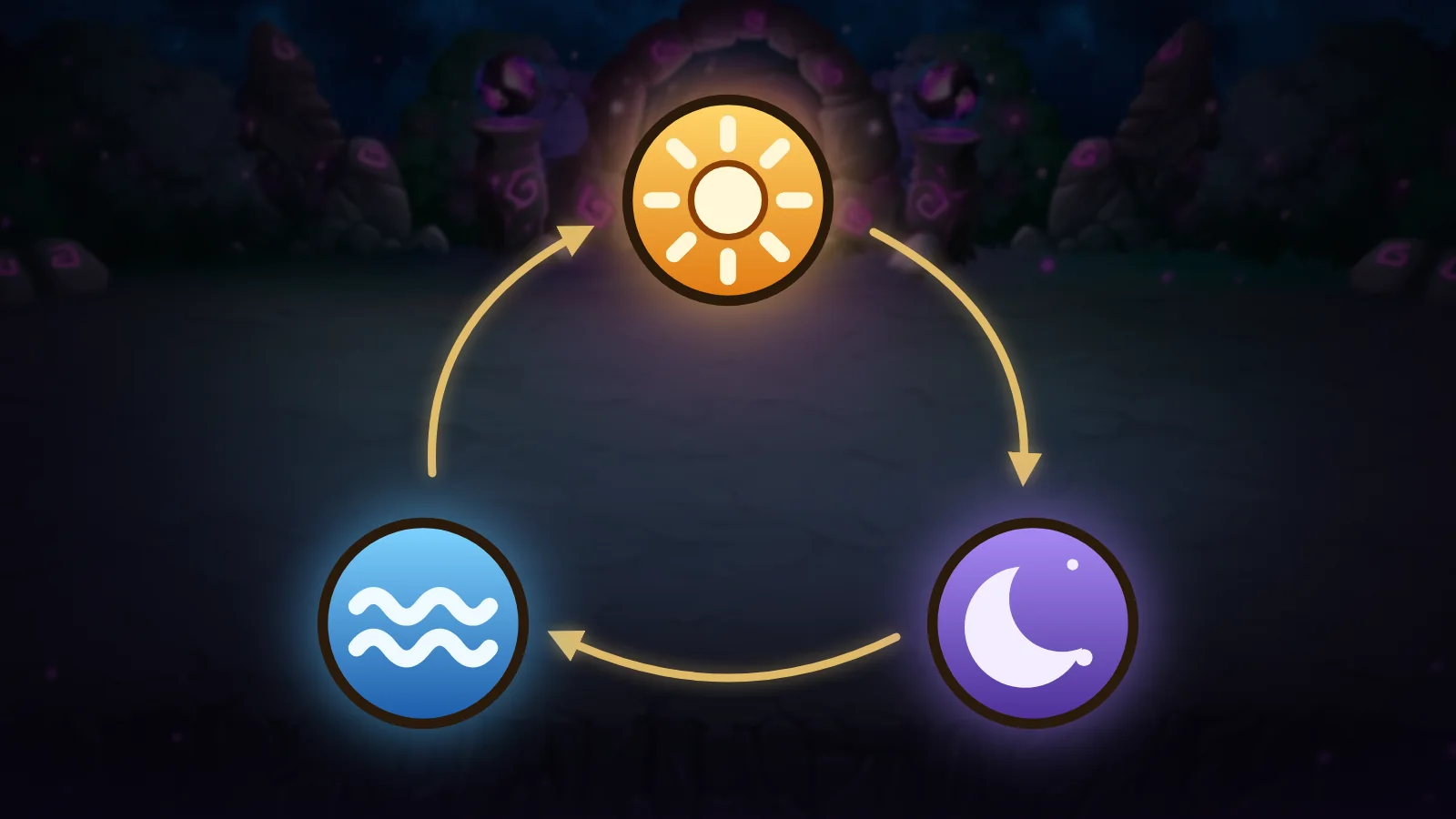
The game’s name has always hidden a pun: Tri-ara, the land of the three aras. An ara is an altar, and every champion is now sworn to one of them: the Sun, the Moon or the Tide. Its emblem sits next to the name on the card and, in combat, it changes how much each hit hurts.
The cycle
- The Sun drives away the Moon.
- The Moon rules the Tide.
- The Tide swallows the Sun.
Every hit looks at the attacker’s ara and the target’s. If the attacker’s ara beats the target’s, the hit deals 10% more damage; the other way round, 10% less. Nothing changes between champions of the same ara, and pets and beasts have no ara at all: they are neutral against everything. In combat you will see it in the damage numbers, with an arrow pointing up or down.
The aras are split in thirds within each role and category, with some logic to them: paladins, desert and fire lean towards the Sun; the undead, elves and shadows towards the Moon; pirates and frost towards the Tide. None is better than the others.
What it is worth
With everything in your favour (say, three suns against three moons) and equal power, you win around three matches in four. That is roughly the same as having 10 to 12% more power. But that is the extreme case: usually only some match-ups favour you, and then the edge is a few points.
Which lane matters most
To see where the ara matters, remember who hits whom. The tank can only reach the enemy tank; the fighter, the tank and the fighter; the shooter, all three. And everyone goes for whoever is in front first: while the tanks are standing, they take almost every blow in the match.
That puts the tanks at the heart of the aras:
- Your tank’s ara decides how much you take. If it beats the enemy fighter’s and shooter’s aras, all their damage on it drops by 10%.
- The enemy tank’s ara decides how well your attackers do. A fighter and a shooter whose ara beats it deal 10% more to it.
I measured it with the game engine, over thousands of matches between teams of equal power, each champion carrying one skill:
| Situation | Wins |
|---|---|
| No ara edge | 50% |
| Only your tank beats the enemy tank | 55% |
| Your fighter and shooter beat the enemy tank | 56% |
| Your tank beats their fighter and shooter | 57% |
| All three of yours beat the enemy tank | 59% |
| Everything in your favour, three against three | 79% |
Each favourable match-up adds a few points, and they stack. Since the tank is involved in most match-ups, both dealing and taking hits, it is the lane where an ara change moves things the most.
The league box tells you
You do not need to do the maths. In the arena, the league box shows your next opponent lane by lane: your ara against theirs at tank, fighter and shooter, with an arrow on each row. Above it sits a verdict such as "The gods grant you 59%", which is the win chance the aras alone give you at equal power. Below, there is a line for every lane that tips one way: "Your tank prays to the Sun, which drives the Moon from their tank".
From that same box you choose which deck to put in play. The odds on the tavern’s betting board also take the aras into account.
Should I swap a starter for their ara?
This is the real question, and the short answer is: only if the swap costs you little power. I tested a substitute tank that is weaker than the starter but has the favourable ara:
- If its ara beats all three rivals, a tank 10% weaker ends up level with the starter.
- If it only beats the enemy tank, being just 5% weaker is enough to lose more than you gain.
The rule I follow: the ara breaks ties between champions of similar power, within about 5%. Do not bench a clearly better champion because of the colour of their emblem.
Decks: the line-up you prepare
Line-ups are saved as decks. You have two (five with the Order of the Crown) and at any moment one of them is in play: it is the one that fights in the league, the cup and friendlies. The deck in play stays as it is, except for filling an empty lane; to change your line-up you build another deck and put it in play. That spends the round’s change (three with the Order), which comes back at match time, just as your next rival is drawn. Pets and gear can be changed freely.
Since you know your rival a day ahead, the idea is to keep your second deck ready for the match-up that worries you most. With six champions you have two per role, so you can cover two aras in each lane; with the Order’s fifteen champions and five decks, you can keep a deck against every ara. If you are only going to change one piece, make it the tank.
What about a single-colour team? Against mixed teams it breaks even (48% in my tests), it crushes the ara it beats and it suffers against the one that beats it. It is a gamble; variety is insurance.
In short
- Sun beats Moon, Moon beats Tide and Tide beats Sun: 10% more or less damage per hit.
- A full edge is worth about 10 to 12% power; a single match-up, a few points.
- Look at the tanks first: yours takes the hits and theirs receives yours.
- The ara breaks ties; power rules.
- Keep a second deck ready, at least with a tank of another ara.
For everything else that makes a champion good, there is the champion guide.