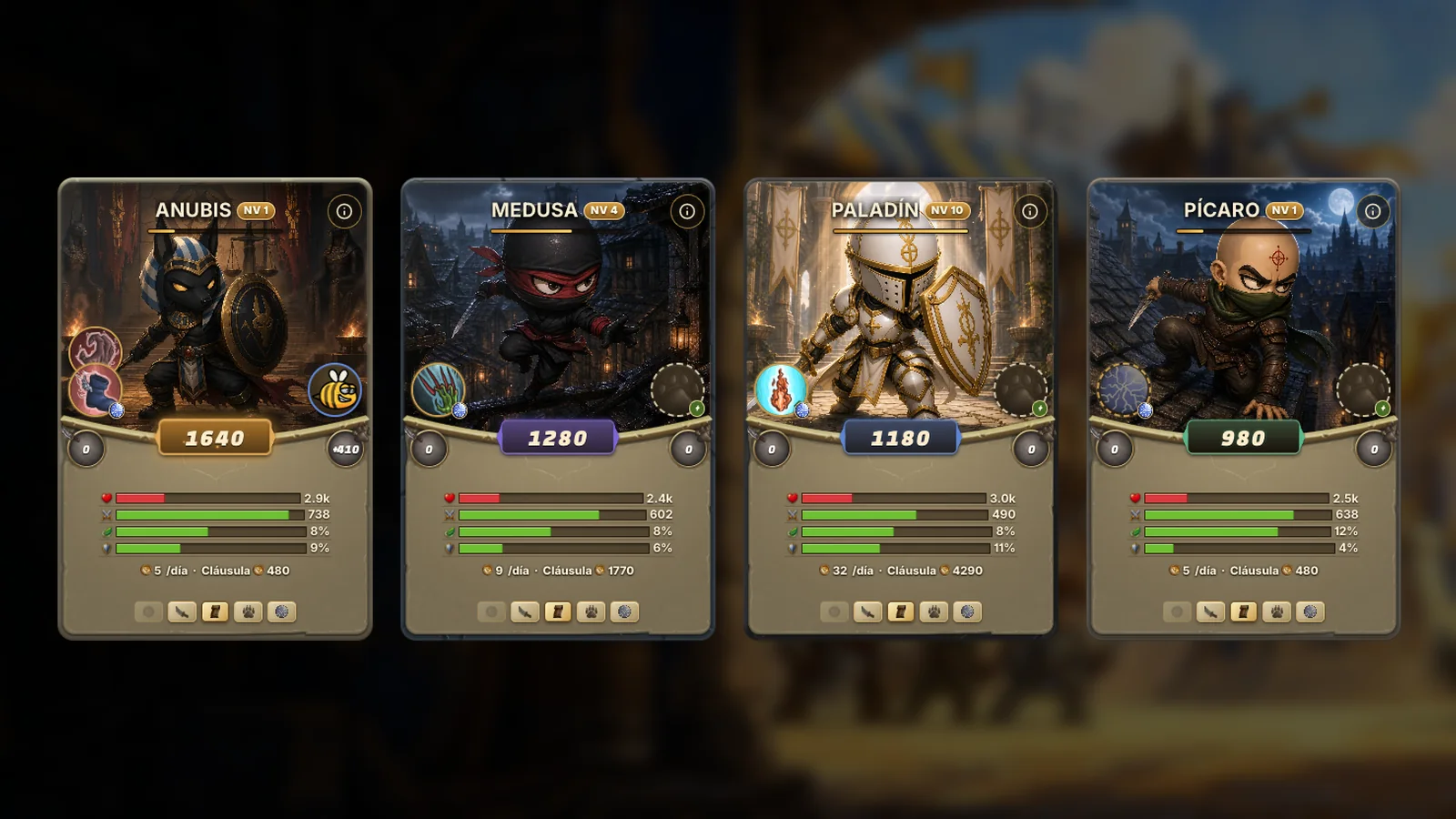
Triara has 288 champions in its catalogue, spread across five categories. Every one that joins a team gets its own name, so a "top ten" list would not help you much: the one that matters is whoever shows up among your league’s available champions this week, or whoever your neighbour owns. What helps is knowing how to read a card. This guide covers what I look at, with figures from the catalogue and from simulations run on the same combat engine the game uses.
Power in a single number
The big number on the card is power. It combines the damage of each hit with effective health, meaning health scaled up by everything resistance and agility save you. The four bars on the card are:
- Health: the points it can take.
- Damage: the real hit, varying by up to 20% either way.
- Agility: the chance to dodge, as a percentage, capped at 50%.
- Resistance: the share of damage it absorbs, as a percentage, capped at 80%.
Power is what the game uses to work out win chances and betting odds, and it is the best quick reference for comparing champions. Combat also rewards small differences heavily: in my simulations, with everything else equal, a team with 4% more power wins a little over six matches in ten.
The five categories
From lowest to highest: Rookie, Prospect, Pro, Star and Legend. These are typical figures for a freshly signed champion of each, with no levels or gear:
| Category | Power | Value | Wage |
|---|---|---|---|
| Rookie | 1,500 | 250 | 3 |
| Prospect | 2,050 | 500 | 7 |
| Pro | 2,650 | 800 | 15 |
| Star | 3,900 | 1,400 | 28 |
| Legend | 5,400 | 2,400 | 45 |
The biggest jump is between Pro and Star: almost 50% more power. No Pro, not even fully developed, reaches a typical Star. In Gold and Platinum, the Star is the signing that changes a team.
There is a wide gap inside each category
There is more than 50% power between the weakest and the strongest Rookie, and something similar happens in every category. So always compare a champion’s power with the typical figure for its category: being well above it is worth almost as much as moving up a category.
It is also worth money. A Rookie in the top 10% gets close to an average Prospect, costs roughly a third less (about 320 coins against 500) and earns 3 coins a round instead of 7. Developed to level 10, one in twelve Rookies beats the typical Prospect. In Bronze, those top Rookies are the best signings per coin.
Role and lane
Every team fields a tank, a fighter and a shooter, each in its own lane. The tank can only reach the enemy tank; the fighter, the tank and the fighter; the shooter, all three. And everyone hits whoever is in front first: while the enemy tank is standing, it takes almost every blow.
- Do not compare a tank’s power with a shooter’s. Tanks hit softer, so their power comes out lower by design. Compare them with other tanks.
- Tanks are scarce. Only one in six Rookies and Prospects is a tank, and one in ten Pros. If a good tank shows up among your league’s available champions, do not let it go.
Development pays in any lane
A level 10 champion has 20% more stats than at level 1. I pitted identical teams against each other and raised a single lane of one of them to level 10: that team went from winning half its matches to winning around 70%, whichever lane it was. The takeaway is simple: developing pays in every position, and whoever plays every day gathers the most experience. Starters earn the full experience; the bench, half.
Skills: two slots, one orb each
Each champion learns up to two skills, each one costs an orb, and orbs only come from the cup podium. It is worth choosing carefully. Which skills a champion can learn depends on its role, class and race.
I measured each skill by giving it to a single champion and pitting that team against another of equal power with no skills. These are the ones that raise the win chance the most from 50%:
- Tank: Grace (elves) comes close to 20 points. Behind it, at 15 to 16, come the knight skills (Hard Block, the Retribution that sends back part of the damage, and Tough Skin), Sea Dog (pirates), Shadow Cloak (assassins) and Fortress (warriors and knights).
- Fighter: Backstab (assassins), Duelist (warriors), Lucky Shot (pirates), Flurry (assassins and pirates) and Shield Bash (knights), all 14 to 17 points higher.
- Shooter: Sacred Light (healers), about 20 points; Deep Freeze, Unstable Magic and Arcane Power (mages), 14 to 17.
No skill hurts: every one of them raises the chance to win. One caveat: the race skills that add damage (Fury, Curse, Hellfire and Predator) do little on a tank, which hardly hits; on a fighter or a shooter they pay off.
A champion’s second skill adds less than its first: about 6 points on average, against 10. With few orbs, giving another starter its first skill pays more than giving the same one its second. When the second comes, the best pairs reach about 30 points: Grace and Duelist on an elf warrior, or Fortress alongside Hard Block, Grace or Retribution on a tank.
Pets
Every starter can bring a pet that fights by its side; a tank pet also protects its champion by taking hits for it. Pets level up with their champion’s experience and have no ara. They only come from your league’s daily sighting, so each one counts.
Before you sign
- Compare its power with the typical figure for its category and role.
- If it is a tank and a good one, it is probably the hardest piece to replace.
- Check which skills it can learn given its class.
- Check its ara: it gives you options against certain rivals (more in the aras guide).
- Think about its wage and its future value: a cheap youngster who grows is the best deal in the game.
Everything about clauses, sales and payroll is in the post on signings.